Tuesday, 2 February 2016

Harry Potter Book Night - A Night of Spells


Calling all witches and wizards - and any muggle wannabes, too!

Join us at Hogwarterstones (see what we did there?) on Thursday the 4th of February for Harry Potter Book Night, our annual celebration of all things mysterious and magical!

If you're feeling creative, why not contribute your most effective and enchanting spell to our highly sought-after Hogwarterstones Book of Spells, a tome so powerful that in the wrong hands could bring down civilisation as we know it? Or, cook up your most intoxicating potion recipes, and commit them to our anthology forevermore.

As if that wasn't enough, we will also have with us a certain nasally-challenged special guest - yes, the Dark Lord himself (no, not Peter Mandelson). He-Who-Must-Not-Be-Named will be joining us for a game of Pin The Nose On Voldemort, so start getting some practice in! 

Plus, of course, we'll still be open for business, selling all your prescribed wizarding textbooks, as well as the brand new Harry Potter Magical Creatures Colouring Book and the beautiful Illustrated version of The Philosopher's Stone - don't forget your galleons!

The official event starts at 4:00, but we'll have Harry Potter colouring out all day.

Don your robes, grab your wards, jump on your brooms, and join us for a magical evening!


Love, Owen

Tuesday, 17 November 2015

Thoughts on Selznick's The Marvels


Our former bookseller Lewi, poet, writer and aficionado of all things art and Victorian, posted an interesting comment on Facebook about Brian Selznick's beautiful book The Marvels - nutritious  food for thought:

"I go to bed tonight a little saddened. I have just finished reading the most beautiful book, recommended to me by my even more beautiful friend Patty, which is 'The Marvels' by Brian Selznick. It is a tale of two halves where 60% or so consists of hand-drawn scenes which tell one story (and reminded me of a visual representation of a Sigur Ros song), while the rest is dedicated to the written word, which frames the first story in another incredibly delicate, plot-twisting, happy-and-sad-at-the-same-time theme which rounds everything off so sweetly. Without giving too much away, there are a gay man and a gender-fluid girl in the story (who just so happen to be gay and non-binary without having the story revolve around those aspects), which, considering the book is primarily aimed at teenagers, I think it is an absolutely incredible way of showing diversity and a 21st century attitude to "different" types of people with whom we share this planet, no? 

However, upon looking to amazon to see what others thought of it, I was upset and, to be honest, quite angry about how many adults consider the aforementioned themes as, and I quote, "controversial", "not suitable for a young audience" and "requiring parental involvement". 
I'm sorry, but what? How on earth can the account of a fictional man expressing his love for another man, and a girl who does not wish to necessarily be represented as such, be considered as "not suitable" and "controversial"?! How else will teenagers, especially those who are struggling with gender and sexuality identity issues, empathise with others, real or not, who are or have gone through the same thing? How else will they learn tolerance for homosexuality and so forth, if this is being attempted to be taken away from them by fully grown adults - a lot of those reviews were from teachers too! What is it going to take to make people realise that it is okay to have gay and gender-fluid characters in books and for it not to affect the storytelling and the plot and so forth? 

I don't know if it is because of the friends I have or how I was raised or my liberal, mostly left-wing views but I see absolutely no problem with any of it in the slightest, and people suggesting that others do not buy this book for their children because of those "issues" (yet they are quick to say how good Selznick's other books are, which contain heterosexual, gender-conforming characters) are purely adding to the problem by creating a stigma around two already very sensitive issues. I thought this was 2015, not 1815. Many, many people are becoming more open-minded, I know, and I think that is fantastic, and I know those reviews are just electronic words on an electronic screen but they have dampened my spirits and shed a perhaps unwanted light on the fact that we still have a long way to go in the name of social equality."

Thursday, 12 November 2015

And the winner of our Halloween Short Story Competition is...

FRANKIE HOLLIS, age 9, from Witney!!!

Frankie displayed a ferocious imagination with this little terrifying tale, with an incredible attention to gory detail. What send an icy shudder down our backs was the image of stairs covered in hair and moss. Reminded me of a brief scene from the Pet Sematary film (which Frankie must promise to not watch for another 10 years or so!).

And you will be pleased to know, Frankie, that I've showed your story to horror author Adam Nevill, and he approved of it very much!

So without much further ado, here's Frankie's tale of doom!

Thursday, 22 October 2015

Review: Adam Nevill's 'Lost Girl'

I’ve been a fan of Adam Nevill’s tales since Apartment 16 made me too chicken to switch off the lights at night. Since The Ritual made me obsessed with Scandinavian folklore and my Germanic  heritage demons that still haunted my mother (there’s a tale there). Since Banquet for the Damned created a discordant homage of twisted love to the dark beauty of St Andrews and the unfathomable horrors of a Lovecraftian mind. Since the cracked hands of my inner evil porcelain doll clapped enthustiastically to the Victorian horrors unfolding in House of Small Shadows.

So far Nevill has ticked all the boxes of my favourite kinds of fears.  It’s like he is an evil wizard pulling all my bad dreams out of my head like a rope of threadbare, rotten knotted handkerchiefs, twirling my demons like Mickey in a Fantasia directed by James Wan or John Carpenter. Only horror fans might appreciate that particular addictive (if not slightly masochistic) joy.

The paranormal is Nevill’s specialty, and I imagine it will always feature to some degree in his tales of doom. But there is a new side to him, which I can only describe as a modern Dickens. Last year, with the publication of No One Gets Out Alive, Nevill dealt with a modern horror that has touched too many of us: unaffordable housing and unstable jobs, leaving us in a poverty so grinding that we are at the mercy of rogue landlords. Nevill might have exaggerated it somewhat (although I have met people like Knacker McGuire, which makes this book all the more terrifying) – but there is illustration in exaggeration, and Nevill’s recent books have become sharp magnifying glasses pointed at contemporary societal ills, not instilling an indescribable horror but stirring up the familiar already there. He’s done poverty, the housing crisis and unregulated rental markets.

His latest, literally, goes more global. It’s not post-apocalyptic, it’s bang in the middle of it. Lost Girl is not just what some called a version of Liam Neeson’s 'Taken' – though if you prefer to read it that way, you certainly can; it makes a damn fine thriller. But there’s more to it than just the Leeson meme we’ve all seen. Set in the near future, in a world that is increasingly crumbling under the effects of climate change in which man has gone past the point of no return – ecological disasters, food shortages and water rationing and the resulting mass migrations to escape their doom to not much more habitable areas –, in a Great Britain that is collapsing under the strain of an apocalyptically hot summer, killing pensioners off like flies,  an ever-widening gap between the rich and poor, where only the rich can afford to get decent food and protection from an insane organised crime wave so infiltrated in society that the police is as effective as a cocktail umbrella in a super hurricane of lawlessness…  a global horror, a likely horror, a horror bound to happen if one just spins the yarn further from now, a horror along the lines of Soylent Green and The Death of Grass, just more brutal and more likely, where “year after year, decade after decade, always worsening, always leaving things changed after each crisis. The past is unrecoverable. Extinction is incremental. There is no science fiction. Advanced physics, inter-galactic travel, gadgets? An epic fantasy, the lot of it. There is only horror ahead of us now."
In this setting of despair, a family moves to Devon from Birmingham to escape the constant flooding, to a quiet, still somewhat idyllic place where self-sufficiency protects them from the worst of the food shortages. And it is just then when they feel marginally safe, that their beautiful little daughter gets snatched out of their front garden in a moment of carelessness, and disappears.

Lost Girl must have been incredibly uncomfortable to write – I had to think of Stephen King’s discomfort with Pet Sematary.  While there are autobiographical elements (a family moving from Birmingham to Devon with their little daughter), the thought of getting your toddler daughter kidnapped from right under your care is every parent’s nightmare. Add that to happening in a world where you can’t expect help from anyone, the law is impotent, a half-hearted investigation is abandoned due to lack of manpower, and the forces you are up against are gigantic. It’s an exploration of the agonies of a father trying to find his child, not knowing whether she is alive or dead, or what horrors might have happened to her. It’s about the lengths he goes to, at the peril of everything he has and is, to save her.

What makes this tale so much better than bland old Taken is how deeply you get submerged into the father’s mind agonising to the brink of insanity with the grief, loss, worry and uncertainty over his daughter’s fate, and the horrific fantasies tormenting him. What adds to the intensity is that he remains unnamed, known only as “the father” through the entire book, making him akin to an archetype that anyone can identify with, where names don’t distract from the state of his soul. It also gives it the eerie effect that made McCarthy’s The Road such a haunting read.

The father is not blessed with the skills and coldness of an ex-CIA man; obsessive research and the help of an anonymous and just as vulnerable agent aids him in tracking down the captors, but often he is tormented by his humanity cracking under the necessity of barbarity to elicit answers from the most callous and vicious agents of his daughter’s disappearance, people so immersed in a world of corruption and violence that the father’s attempts to be threatening at first seem laughable to them. The dilemma the father faces is that in order to save his daughter from the monsters, he has to become one himself. He has to risk losing his ability to be a good father just to get his child back.
The twist at the end I really did not see coming.  I will not give much more away other than that is left open  like a wound in which an infinitesimally small glimmer of hope is the only balm on offer – but in times of doom one is grateful to at least have that.

Lost Girl is a relentless study of grief and loss, not just of a loved one but of humanity in crisis. Nevill skilfully puts it in a setting that makes this tale both larger than life and just a mere anecdote in the sea of peril slowly swallowing our planet, a brief zooming in on an individual fate in a flood of many, a new take on awe-inspiring horror.
The almost prophetic descriptions of a vast refugee crisis (considering Nevill wrote this book before the current problems hit the papers) was almost spooky in its timeliness. And the vivid details of his story-weaving sucks you right out of this world into the one he is master of.


As with all of his books, I advise that you read it at your own risk. But at the same time, you will be glad you did. 

Love, Patty 

PS: Curious? Read the first chapter here.

Sunday, 18 October 2015

Review: Karyn Langhorne Folan's Survivor Stories (Doomsday Kids # 5)


I've reviewed the Doomsday Kids installments previously, still not giving up hope that this fantastic self-published series will receive the due and deserved attention of big publishing houses, just as Howey's Wool, Weir's The Martian and The Rabbit that Wants to Fall Asleep did. 

Amy’s Gift left us hanging cleverly, just giving away enough to know that the Doomsday kids had finally reached the safe haven they had left the Mountain Place for, nearly perishing on the arduous journey there, a near-death Amy rescued mid-birth by no one other than Liam’s mother, and all kids taken to  Survivor City’s hospital to recuperate.

And we all took a collective sigh of relief. Right?

Well, turns out it was too good to be true after all.

Survivors’ Stories, book 5 in the series, starts, it turns out, after considerable time has passed, and the first we meet is not Amaranth or Liam or Nester, but Jax. And it turns out he has not seen his friends for a long time. Slowly, through his, and later, Katie’s and Samir’s eyes (remember him?), it unravels that Survivor City is anything but a picnic. Overcrowded, with not enough food, water, medical aid or even housing for everyone, the supposed haven is a hellhole of starvation and corruption, run by a psychopathic general with social darwinist aspirations in which the weak and ill – all of those not able to contribute –  are cast aside, killed or left to die. A caste-like system controls everyone’s activities and connections, dissidents are being “floated”, former friends kept separated to avoid rebel activity from growing. The nuclear winter may be over, but now another sinister effect of the atomic bombs becomes apparent: with a damaged ozone layer and atmosphere, man is forced to work at night to escape the lethal UV rays and merciless heat.

Before, in the Mountain Place, at least the kids had each other. Now they’ve got no one. Alone in a postnuclear Orwellian nightmare, Jax, Katie and Marty are risking their own lives trying to find each other and their friends. But the brief moments of making contact come at a huge cost.

 I won’t give much more away except that the descriptions of their dismal existence, their attempts to connect, the friendships, loyalties and betrayals they face are heartbreaking, and that the entire time I found myself missing the core gang, of whom you mostly get glimpses and rumours. The horrors inflicted on this little community after they already had to go through so much is gut-wrenching and in some ways a greater horror than “just to die” of nature’s indifferent exposure – their suffering now is a choice of misguided morality and perceived necessity of a twisted man with solid delusions of grandeur.

But there is hope in this tale, and love, intense friendship and sacrifice that makes you plough through the pages, more than likely choking back tears, needing to find out what happens next. And I can guarantee you your heart will be put through the shredder – evidence of Folan’s skill to create wonderful, three-dimensional characters with a depth and warmth you will never forget.

An intensely gripping continuation in the Doomsday Kids series that does not just even for one minute refuse to ease up on being the incredible, cinematic reading experience it is, but also serves as an urgent and topical warning in the current Trident debate. 


Friday, 8 May 2015

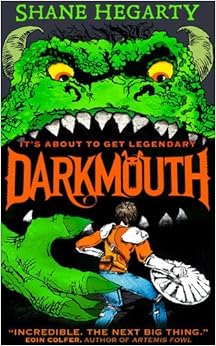
Our Children's Book of the Month: Darkmouth


Shane Hegarty's new gripping tale for readers from 9-12 is setting the bar high for adventure tales - which is why we've chosen it as our Book of the Month.
Fans of Artemis Fowl, The House of Secrets series and even Percy Jackson will utterly adore this.

Twelve year old Finn doesn't really have much get up and go, and just wants to do what every young boy wants to do. That would be fine, except Finn is about to be the latest in a long line of "Legend Hunters". The town of Darkmouth is the last town in Ireland where portals open and let through human-eating monsters (including Hogboons and Wolpertingers) which he needs to destroy. The big problem is, he isn't really very good at it. His father, the current Legend Hunter, is desperate to show him how to be the best he can and to follow in family tradition, but Finn can't understand why it is so important. Unbeknownst to Finn a prophecy has been made and it's all about him! Until he realises how important it is, Darkmouth and its residents will never be safe.

The story is full of fun and page-turning excitement, not to mention a few mishaps with a Desiccator and a few of the neighbours cars. Boys and girls alike will have their half term brilliantly filled with this great book. It's also peppered with wonderful illustrations by James de la Rue.

And if you really enjoy it, there's good news - this is only the start of what looks to be an awesome series.

If we got you curious, head on over to the main Waterstones Blog for an excerpt. :)


Love, Nina


Monday, 4 May 2015

Our Fiction Book of the Month: Perfidia

James Ellroy is no stranger to crime fans. His L.A. Quartet novels have, at the latest, been put on the map for even non-crime readers by their popular cinema adaptations The Black Dahlia and L.A. Confidential.

Ellroy, dubbed as the "demon dog of American crime fiction" by director Reinhard Jud back in the nineties, and whose dark past is a strong source for his writing (the unsolved murder of his mother inspired The Black Dahlia), has just started a second L.A. Quartet, this time set in the Second World War, with Perfidia being the first in the series. It's an epic door stop of a book, with the powerful L.A. noir atmosphere fans have come to love so much, in the context of a world-changing event: the attack on Pearl Harbor.
 
Both the Guardian and the Independent have given it smashing reviews, so it might well be that summer read you've been waiting to sink your teeth into.
 
 
But as none of us would want you to just take our word for it, here is a cheeky sample.